
Garden News | March 2026
I’m sure you’re all as fed up as I am of the perpetual rain and grey skies that February seems to have brought us this year! It’s always exciting to welcome in the new month of March and the hope of more spring-like weather to the garden and this year that’s true perhaps more than usual. It’s that time when we can hopefully start to shake off the frosty, soggy, wind-swept shackles of winter and embrace the new signs of the coming spring. Across the garden, bulbs will continue to pop up everywhere and showing off their pretty heads while the trees and shrubs will be continuing their early tentative attempts at coming into leaf and flower. We’ll be crossing our fingers that the more frequent and longer mild, sunny days will also provide the opportunity for an increasing range of gardening tasks, some of which I’ll tell you about below…
One of the key features of an historic woodland garden are the masses of flowering bulbs on show. Leonardslee really starts to come alive in March and our extensive bulb collection plays a big part in that. Snowdrops will still be enchanting visitors in areas such as Snowdrop Bank on the west side of the middle lakes, in the Rock Garden and under the shrubs in Camellia Walk for instance. Their pure, delicate heads are always a sight to lift the spirits and we’ve enjoyed seeing some new varieties make their first appearance near the Alpine House building after we planted them last autumn.
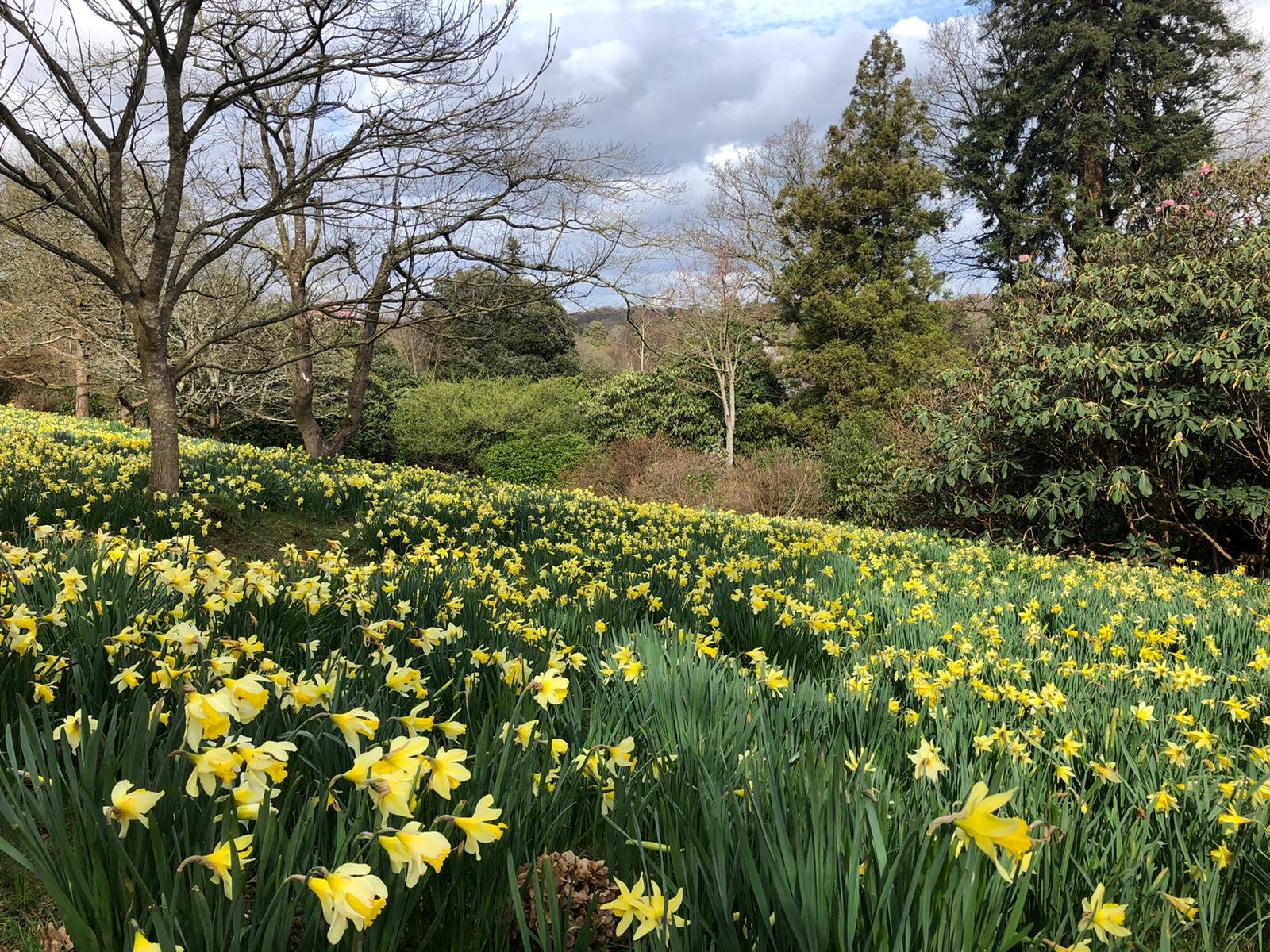
It will also be the turn of our many daffodils to continue their moment in the spotlight. While we enjoyed an earlier start to the season than usual this year (a bonus of the mild winter weather) Daffodil Lawn, just north of the Mansion, is the obvious place to start to enjoy these displays. The lower section in particular will be absolutely covered in a mesmerising carpet of yellow, although we do plan to bulk up this area again even more this coming autumn. At the bottom of Daffodil Lawn you’ll find the Rotunda. This affords fantastic views down the valley, across the lakes and over to Mossy Ghyll where you should be able to spot over 5000 white ‘Thalia’ daffs that were planted a few years ago. I’m also really looking forward to seeing the collection of dwarf and species daffodils growing in the raised brick beds beneath the Red House. Again, we plan to continue to add to this collection over the coming years. The Rock Garden is another key spot for Narcissus lovers, with N. bulbocodium, N. cantabricus and the pinned back rabbit ears of N. cyclamineus being some of my favourites.
Other early spring bulbs to keep an eye out for include the likes of Crocus tommasinanus, which you’ll find in a variety of colours studded throughout some of the grassed areas, Puschkinia libanotica, which is known as the Striped Russian Snowdrop and can be found in the Rock Garden and near the Alpine House and a plethora or early tulips which will be coming up in the containers around the café and event room spaces throughout March.
Although we’re only just getting into spring, some of our world-famous collection of rhododendrons and camellias will be flowering already. If you head to the Loderi Garden for instance, you’ll be able to marvel at the likes of Rhododendron ‘Cornubia’ with its luxurious velvet red flowers or Camellia ‘Cornish Snow’ which has pretty white blooms marked with pink splodges at the base. In terms of our National Collection rhododendrons, you can always count on ‘Seamew’ (near the house) and ‘Seagull’ (near the start of Top Walk) to put on an early display. Obviously, there is much more still to come from these types of shrub across the whole garden but it’s fantastic to see these early signs and a taster of the full spring display on the horizon. Camellia Walk for instance has had a few early flowerers during February including Camellia japonica ‘Variegata’ and C. japonica ‘Little Bit’ for instance while C. x williamsii ‘Cherub’ has been busily blooming down in Camellia Grove for a number of weeks now. ‘Cherub’ is especially interesting because it was bred by Sir Giles Loder during his time at Leonardslee and is unique to us so make sure you catch it while you can.
As discussed in last month’s newsletter, the big job in March that we’ve all been waiting for is the green light to continue our renovation pruning of overgrown rhododendrons and camellias. A few years ago, we would have waited until after flowering to start this important restoration process, but the thinking now is that doing the work in March gives the plants a full twelve months at least and the best chance to recover quicker and flower again sooner, all being well, next year. Admittedly we’ll lose the flowers for this year on the plants we choose to tackle, but in the long run this method is much better for the plant itself. In February we tackled azaleas around the back of the Rock Garden and the next phase of camellias in Camellia Grove. In March we’ll move on to areas such as Middle Walk, the Coronation Garden and Eucalyptus Lawn to name but three. In some cases, we’ll be reducing the size of the plants dramatically, so we’ll give them a good feed and mulch afterwards to make it as unstressful as possible. The result of this work will be to either bring flowers back down to eye level, open up lost views or simply to stop the shrub becoming too large for the area.
March is also the month when the lawns will begin to think about growing again so we’ll be busy tackling some turf tasks, and this is something that you can try at home too. Before we start actually mowing later on in spring, perhaps even by the end of the month, we’ll get on with plenty of re-seeding and re-turfing for instance now that the risks of frost are becoming a little less likely. The temperatures will be increasing slightly in March but there will also be plenty of moisture in the soil so March is an absolutely ideal time to apply grass seed on bare patches such as on the Mansion Lawn and along Interlude Drive here at Leonardslee for instance. We’ll also use fine, sandy soil to fill in any dips and divots as well as repair any damage to our lawn edges. Spring is also a great opportunity to apply a fertilizer to underperforming or hard-worked areas. At this time of year, a nitrogen-heavy feed will encourage leafy growth to make the lawn appear lusher. Feeding your lawn will also increase vigour and help prevent weeds and moss from establishing. Fertilisers should be applied when the soil is moist, or when rain is expected, hence why March should be perfect. Although autumn is the usual time to carry out scarifying and aerating, this can also be down in early spring. Scarifying involves scratching out the build up of thatch and moss around the grass roots and can be down with a stiff metal hand rake on smaller areas or with a powered machine on larger lawns. You’ll be amazed at how much will come off and can be added to the compost heap. Aerating involves studding the lawn with holes to improves drainage, root growth space and access to oxygen. This can be done with a garden fork on small lawns and again with a powered machine for larger areas. If using a machine, you’ll have the choice of either solid tine (which simply pokes a hole) or hollow tine (which pulls out a plug of soil). I would recommend hollow tine if you can as it will create a better environment for the plant roots. However, you will have to take away the soil plugs (preferably to the compost heap again) and also probably back fill the holes with a sandy loam mixture.
On a personal note, I have some good news this month. I am delighted and honoured to say that I have been awarded the A J Waley Medal by the RHS. The medal recognizes outstanding work in the cultivation of rhododendrons and has been given out annually since 1937. Presented to a working gardener or individual who has made a significant contribution to the cultivation of rhododendrons, it is a prestigious honour often awarded to head gardeners, specialists, or dedicated plantsmen for excellence in growing these plants. I will be presented with the medal at RHS Wisley this month and am so pleased that the hard work that my team and I have put in over the last five years has been recognised.
So, as you can, lots to enjoy here as you take in the gardens at Leonardslee and lots of hard work for us all to be getting on with. By the way, as well as the usual general garden tours this month, our Senior Gardener will be leading another of her Tree Walks on March 11th so make sure you book onto that if you can. Either way, I hope you enjoy your next visit and that we see you all again soon.
Jamie Harris
Head Gardener