

Ashley Edwards
I hope you caught our appearance on Gardeners’ World last month? If you missed it, you can search for Episode 4 of the current series on BBC iPlayer and see what they had to say about the early signs of spring here at Leonardslee.
We’re obviously well into the spring season now of course and if I had to choose one month of the year as the one I most look forward to in the garden here at Leonardslee it would have to be May. Notoriously this is when the floral display here reaches full rainbow peak with our world famous rhododendrons, camellias and magnolias bursting into bloom wherever you look. The carpets of bluebells down near the lakes will also be at their best this month and some of my favourite early herbaceous plants such as foxgloves and alliums also having their moment in the spotlight too. There will be so much for our visitors to enjoy here this month that a single visit really won’t be enough to catch it all, so I hope you’re all able to experience the gardens as much as possible during the coming weeks.
One of the first points of call during May should be The Loderi Garden. The plants growing there are the reason why people travel for miles to come and see us, so that should be on everyone’s visiting list this month. As you walk the myriad of paths that meander toward The Dell through this part of the garden you’ll be stopped in your tracks by the range of colours, the gorgeous scents and the sheer scale of the rhododendrons and azaleas blooming away in here during May. Some of my favourites include the deep, glossy red of Rhododendron ‘Oporto’ for instance or the unusual parma violet-coloured ‘Saint Tudy’. However, the real stars of the show here are the Loderi hybrids. Often cited as the finest Rhododendron hybrid collection ever created, these are termed as ‘glamour’ Rhododendrons and for good reason. Back in 1901, twelve years after purchasing Leonardslee, Sir Edmund Loder started to breed his collection. He took the pollen from a R. griffithianum sourced from his friend Colonel Godman’s glasshouse across the road at South Lodge and combined that with the female flower parts of his own R. fortunei and the rest is history. In truth, it took six years for his first cross to flower but he eventually created over 30 Loderi hybrids, some of which didn’t flower until after he sadly passed away in 1920. The griffithianum parentage provided the large flowers and attractive bark that you see on the plants today while the fortunei genes gave their delicious scent, hardiness and tree-like growth. Incidentally, the scent of a Loderi rhodie in full bloom has to be my most favourite smell in the whole World! Make sure you grab a nose-full when you’re next passing one!
Today, Leonardslee is the only place where you can find a complete collection of Loderi hybrid rhododendrons and the original specimens truly are a sight to behold. Incidentally, Sir Giles Loder (Edmund’s Grandson) planted the Coronation Garden up on the eastern slopes from Leucothoe Pond with another collection of these hybrids, to mark the coronation of Queen Elizabeth II in 1952. If you miss the original Loderi hybrids flowering in early May, the younger specimens in the Coronation Garden are usually slightly behind their siblings and will flower a little later. We’re now starting to create additional locations for our important Leonardslee hybrids, including the Hillside Garden. This is an area that was only opened to the public last month so please take a stroll through here when you can and see the hard work that my team of staff and volunteers have put in getting this area open for the first time in over a decade. As well as the newly planted young Loderi hybrids you’ll also find some summer-flowering rhododendrons such as R. ‘James Burchett’ as well as plenty of specimen and Champion trees.
The Loderi hybrids, together with many other Rhododendrons bred here at Leonardslee by generations of the Loder family, form part of our Plant Heritage National Collection. Look out for signs and further information on some of the key specimens throughout the garden and see how many you can spot. Some of my favourites include ‘Leonardslee Primrose’ near Clapper Pond for example and which was introduced by Lady Loder after Sir Edmund’s passing and ‘Loderi Georgette’ which is the pinkest of all the Loderis and can be found near the wallaby enclosure. ‘Leonardslee Primrose’ won the Plant Heritage Threatened Plant of the Year public vote in 2024 and it started to flower here in mid-April so catch it while you can. Some of the other plants within our collection that have started blooming include ‘Seamew’ and ‘Pink Glory’ near Camellia Walk and ‘Prince Charming’ on the path from the Play Area for instance.
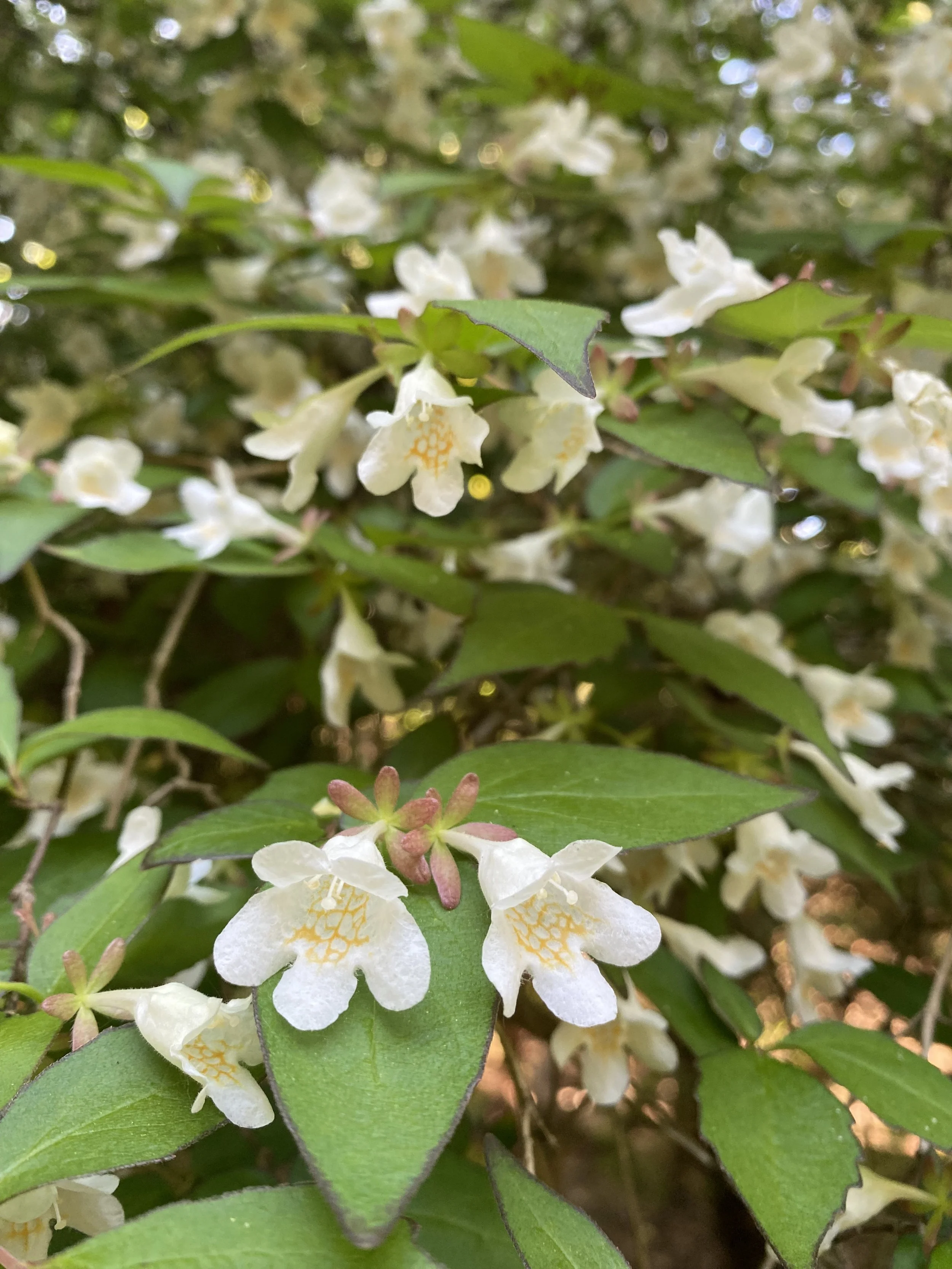
While you’re in the Loderi Garden, make sure you try and find our Diabelia spathulata shrub along Middle Walk. Covered in drooping bell-like white flowers, it has an interesting history. Although relatively common in Southern Japan, when it was introduced to the UK in 1880 it proved difficult to keep alive and Leonardslee is now one of only two known locations of this plant in the whole of the British Isles.
Another unique and fascinating part of the garden that you really cannot afford to miss in May is of course the Rock Garden. The first part of the garden to be created by Sir Edmund Loder once he purchased the estate and constructed by Pulham & Sons (the Royal-approved Chelsea designers of their day), this area really is an oasis in May. We started to carry out some restoration investigations on the Pulhamite rock structures in here during part of April but it’s now open again just in time for the big display in there. The cloud-pruned Azaleas will be in full bloom this month and perfectly complimented by the emerging Acer foliage above and splashes of newly planted alpines, ferns and herbaceous perennials beneath. With the trickle of the waterfall and the birds and insects flitting merrily about, this is a perfect place to get lost and experience true serenity. Some particular May highlights in there include the Exochorda macrantha near the pond for example with its clusters of sweet white blooms, the acid green foliage of the British & Irish Champion Acer palmatum ‘Seiryu’ up on the Eastern ridge or the stunning orange hairy indumentum on the underside of the Rhododendron pachysanthum leaves down on the main path.
To the north of Camellia Grove lie the Bluebell Banks. Aptly named, these slopes on the west side of the lakes are covered in floral rivers of Hyacinthoides non-scripta, or Bluebells to you and me, in May. Delicately scented and a true sign of spring, bluebells are also a key indicator species for ancient woodland areas like Leonardslee. We hope that this year will be a great one for bluebells again and you can also spot them up at the north end of lakes where they congregate with wood anemones and spring primroses.
While you’re enjoying all that the garden has to offer during May, the garden team will be busying themselves away with plenty of important tasks. The likes of turf care will become more frequent as temperatures and daylight hours increase so we’ll be making good use of out lawn mowers and edging shears this month. We’ll also be finishing up any key planting projects before the weather becomes too hot and dry for young plants to tolerate, so look out for new plants popping up in and around the Herbaceous beds and in the borders around the house too. Just as our ornamental plants will be putting on a growth spurt in May, so too will the weeds so we’ll be down on our hands and knees in the formal beds and borders again this month. That also applies to pond weeds too so we’ll be manually clearing emerging duck weed from the lakes in May, first leaving it on the side of the water for any aquatic insects to safely return to the water.
Bluebells
Another of the key jobs here in May, and one you can try at home perhaps, is to propagate our hydrangeas by taking softwood cuttings. This is a great way to get free plants and now is a great time to try it. Young plants tend to root more easily but either way, choose a non-flowering shoot and simply cut off a section about 10 cm long just above a bud or node. Then, with a sharp knife cut this section just below the lowest node, remove the lowest set of leaves, pinch out the soft tip and dip the cutting in some rooting powder or gel. Insert it carefully into a pot filled with gritty compost, water it and cover it with a lid or plastic bag. You can have several cuttings in a single pot at this stage. Provide some bottom heat if possible but this isn’t essential. Your cuttings should be kept in good light but not direct sunlight and you should remove the lid or bag every now and again to provide ventilation and make sure you keep the cuttings misted so they don’t dry out. Rooting should occur with 4 weeks, at which point they can be potted on into individual pots. Good luck!
There are plenty of garden tours during May to look out for. I’ll be giving a Head Gardener tour on the 14th and the 20th while our volunteer-led garden tours run every Monday apart from the middle week when they switch to a Wednesday.
I hope you’re as excited as I am to experience Leonardslee in the month of May again this year. It really should be a sight to behold. Have a great month and I look forward to seeing you here in the garden again very soon.
Jamie Harris
Head Gardener
